
Interview with Christopher Tucker – A Planet of 3 billion

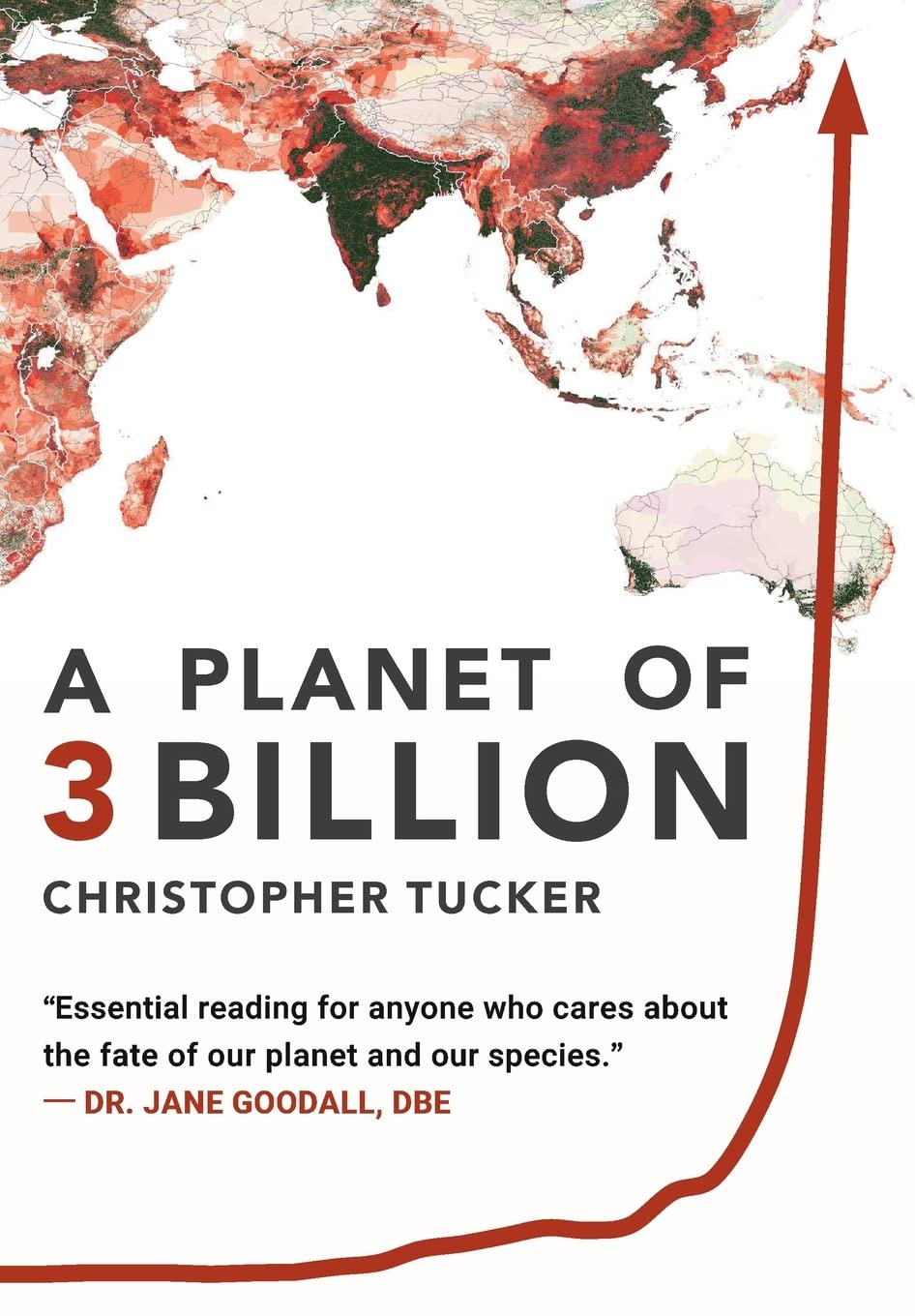
In a column I published last week, I mentioned the influence of an author and book that changed my thinking about population. That author is Christopher Tucker and the book is “A Planet of 3 Billion” In this column I interview Christopher in follow-up.
First, on our lengthy Zoom call, Chris reminded me that he delivered a TEDx talk shortly after the book was published. I just rewatched it, and it is a great talk, as it has a number of the incredible visuals and charts he had in the book. Here is his TEDx talk I would highly recommend you taking 15 minutes to watch. He addresses the ignorance that most people have about human population. And puts forth what are clear visions of the benefits of lowering the human population. So, if you have any resistance to the concept of reducing our current level of population to 3 billion, you will be educated at to why this is an ideal level of humanity for Planet Earth.
Chris is the Chairman of the Council of the American Geographical Society Click on his picture here to learn more about Chris.
On to the interview.
David
Chris, thanks for doing this interview. You know how much your book and our subsequent conversations about human population has changed my thinking on the topic.
Chris
My pleasure
David
Since I read your book, I have come up against several pushbacks on our shared belief that the current human population is environmentally and ecologically too much. The pushbacks are sourcing Malthus, Paul Ehrlich and the ‘Chinese One-child policy’ as failures. Please comment on that. What do you say to these doubters.
Chris
All of these that you mention have or had cultural agendas. They are forms of substantiation for held policy beliefs that have been culturally based or were just too narrow and therefore false. Malthus was viewing the United Kingdom only and not understanding how trade could change his vision. Ehrlich was just wrong and his book damaged the perception of population growth. The Chinese one child policy was not a failure, it did work but again there were cultural reasons for why it was perceived as a failure. Sexism – that boys were better than girls – played a role.
Just today, in the Atlantic, there was an article about how there will be too few people well into the future. That is a cultural and policy bias, again. If you accept that premise you are accepting a particular cultural perspective.
Remember, the goal of my project, A Planet of 3 Billion, was solely driven by my attempt to understand the planet’s long term ecological carrying capacity, with a focus on population growth. That was and is my driving concern. I was answering Joel Cohen’s 1995 question from his book “How Many People Can The Earth Support?” Other folks in this space have their own cultural projects they are pursuing, and it is important for readers to always ask “what is the cultural project behind words that I am reading.”
David
Please address the view of E. O. Wilson, who, a decade or so ago, suggested that humanity should set aside half the planet for nature in his book “Half-Earth”. Your highlighting of all the ecoregions in your book and TEDx talk are a counter argument. Is that correct?
Chris
Not really. I see my approach as complementary. E. O. Wilson did have sound premises for his vision. He understood the need for geographically coherent regions for wildlife growth. Many of his acolytes actually embraced the ecoregions methodology to implement data driven strategies for tracking the percentage of our planet’s historic wildernesses that humans have deleted or annihilated (those are my words, not there’s!) In my book, I law out some issues I have with how to delineate the 50% that we need to leave to wilderness. The 470+ ocean dead zones. The thousands of toxic sites. The millions of miles of paved roads that have permanently transected wildernesses and migration paths. The ever growing metropolitan zones and vast intensively cultivated agricultural areas that have replaced the wildernesses in which they first got their toeholds. The geography of the human footprint makes his simple 50/50 vision a bit unwieldy.
David
You just referenced what I would call an ignorant article in the Atlantic. If the Atlantic gets is wrong, that only highlights my real frustration with how superficially or ignorantly mainstream media gets this issue wrong. Care to comment?
Chris
Yes – “The Great Depopulation” by Derek Thompson, an interview with economist Jesús Fernández-Villaverde. Again, what is the cultural project or policy bias behind any article that you read? It is easy to read something and try to compare facts. But there are probably 20 different cultural projects that shape most commentary on population, and you need to know which cultural project is at play. I agree with you and suggest that, perhaps, journalism no longer exists as we knew it. The basic question I have lived, thought about, and put in the title of my book is: what long term ecological carrying capacity of the planet. How Many People Can the Earth Support? That is my cultural project. The interview between Thompson and Fernández-Villaverde betrays a common narrative from those who adhere to the cultural project of neoclassical economics, and its many mistaken beliefs. I will leave it there, but would be happy to go toe to toe with them, any day.
David
You wrote in your book that humanity is increasing our population by 80 million people, or as you say 10 New York Cities or one Germany a year. Is that still the case? This is close to one percent growth a year.
Chris
Well, that is more from my TEDx PENN talk in 2023. Since then, global population growth dropped to only add 71-72 million to the world population min 2025. So, 7 New York Cities and one Thailand? So we are just below one percent added each year now. People talk about the impending population collapse as we are increasingly crushing our planet each year.
David
Wow! That is simply amazing. How can people, smart people, be worrying now about the human depopulation of the planet?
Chris
That is a long discussion, for which we do not have time. There are cultural projects at play. If you believe an economy can never sustain itself unless global population grows continuously forever (which is a patently ridiculous concept, BTW) then you must focus on the fact that in several decades, population will peak, and then steadily decrease, just as it has steadily increased for a couple/few hundred years. If your entire world view is based on GDP growth, and certain mythologies around how to make social safety nets solvent, then these demographic trends make you hyperventilate and express thoughts like those in their interview. However, there are other ways to achieve prosperity and well being on a more sustainable planet without ever growing GDP. As I say in my book, it is time to reimagine economics for an era of degrowth.
David
The actual birthrate, the Total Fertility Rate globally, is decreasing. When, naturally, will the population actually start to decrease?
Chris
Current projections are that somewhere between 2064 and 2080 the population will begin to decrease, at somewhere between 9.7B and 11B, depending on the projection you subscribe to. So it will ultimately decline, but not before massive ecological degradation, and increased probability of increasingly large, frequent and acute bouts of human misery.
David
After we connected around the time of Covid, you discussed with me an attempt to get the world to embrace a 1.5 Total Fertility Rate globally. I think the goal was by 2030. Where are we on that?
Chris
Well, humanity has blown through that. No way will it drop below 1.5 by 2030. That was an attempt to model out what might be required to get to a global population of 3 billion, as I call for in my book, in a reasonable timeframe. My model, which I wrote about here (https://www.whp-journals.co.uk/JPS/article/view/761), had us reaching 3 billion by 2120 – in roughly a century. By simply investing in the empowerment and education of women and girls, their integration into the workforce, and access to reproductive health resources, that curve could have been met. It will go slower than that, but there is no reason it has to. We could easily reach 3 billion by 2130 or 2140, and we could begin alleviating the burden on our planet, little by little by 2050 or so.
David
Wow, really! Then from an environmental or ecological view we need to lower the TFR as low as possible. I personally think that civilization as we now know it, will end by 2100 due to climate change. By then the climate calamity will have made humans live in ways that currently are not viewed as civilized. Guess this isn’t a question as much as a statement. What can we immediately do as a species to lower the TFR?
Chris
If we just eliminated child marriages globally we could reduce the TFR from 2.3 to 2, less than replacement rate. Just by establishing that dynamic. We don’t need to have NO children. If we, as my colleague Nandita Bajaj calls for, ended the norm, of “coercive pronatalism: (and I would like to think no one supports coercive pronatalism, in principle), we could let women have the children they want. In the end, we are simply talking about – on average – having 1-2 children per woman (e.g, TFR of 1.5) instead of the current norm of having – on average – less than 2-3 (which would be a TFR of 2.5 and we are already down to a global TFR of 2.2). This really is just not that hard. But what is at stake is enormous. I wish everyone would set aside their cultural taboos and get a little better at basic math, and take this conversation seriously.
David
Both in your book and in your TEDx talk, you mention that another simple way – which has its own benefits – is to globally develop the empowerment of women, increase education for women, integrate women into the workforce and make all forms of family planning technologies available. You even quote Malala in your TEDx talk: “When we educate girls, and when we empower them and give them the quality education that they need, it actually helps us tackle climate change because when girls are educated, they have fewer children” Simple.
Chris
Yes, it is simple. This is not being done is so many countries of the world. If it was, then that would bend the curve of population growth even more. That simple dynamic, of empowering women, is to be embraced because it is a good, in and of itself, It is also good for the planet. If, as you know, one looks at the vertical slope of the global population curve, it began around 200 years ago when it hit one billion. Until the 20th century women didn’t even have the right to vote, so the empowerment of women is only a very recent phenomenon. As we move forward, empowering women will be one of the primary ways to bend the population curve to a lower TFR.
David
One of the reasons I so enjoyed your book is Chapter 12 entitled “A Cookbook for Global Leaders and Global Citizens”. In other words, you list 10 things for humanity to do, collectively and individually. Many writers frame the problem, but you actually list 10 things to do to address overpopulation. We do not have the time or space to go over all 10, but again I want to thank you for supplying actions to take if you want to scale down the growth of human population.
Chris
You are welcome. It is the least I could do if I am ringing this alarm bell. People want solutions, and want to know what they can do. I have a list, and its pretty practical stuff.
David
Finally, in addition to reading your book and watching your TEDx talk, both of which I heartily recommend, what other books or resources might you suggest for readers who really want to dive into this concept?
Chris
I would highly recommend a book “Decline and Prosper!’ by Vegard Skirbekk. It is a source book for anyone wanting to dive into global fertility and its consequences. A brilliant book. Had Thompson andFernández-Villaverde read Vegard’s book, they might have spared us.
David
Thanks for taking the time to talk. Hopefully some of the readers of this column, particularly those of the younger generations may take up this issue as it is essential for new thought leadership and massive global actions to be taken. Soon.
[ To all subscribers: please hit the like button below. If a paid subscriber or a founding member, please comment on this column. I would love to read any comments you might post, as would Chris. I truly recommend Chris’s book and watching his TEDx talk. Please send this column on to someone who would appreciate it for any reason. As a professional futurist and a life-long environmentalist, I truly think that following this line of thinking - reducing the human population to 3-4 billion ASAP - is important for the survival of all living animals and plants on Planet Earth.]
Very impressive, and hopeful! Reading this piece reminds me of when I first heard Ehrlich speak on the subject of Zero Population Growth back in the early '70's. One minor flaw in the interview is that Chris states that Ehrlich got it wrong but does not explain what he got wrong. Guess I'll have to read the book to find out.
Love the provocations, reminders of important issues and new paths to explore. Thank you, David and Chris.