
I Welcome Humanity’s Declining Birthrate

Lots of intelligent people that I listen to or read have spoken quite negatively about the reality that the human birthrate has been and is in decline. Usually, this position is relative to the current cultural and social structures that are in place. For example, take social security in the U.S. The entire vision of this social program is that the ever-expanding young generations will support the declining aging population. Well, in this case massive over population at the young end of the spectrum will take care of the increasing number of “senior citizens” that are now living longer. This seems to be true for most developed nations.
That’s nuts!
To think about humanity’s future looking through the reality of existing social programs means that the people who think that are either resistant to thinking differently or are champions of no longer valid assumptions.
One of the people I most often quote in this newsletter is Arthur C. Clarke. He famously said:
“The goal of the future is full unemployment. That’s why we have to destroy the current politico-economic system”
Of course this quote is perfect for the conversations around TI/AI, as one of the preferred outcomes of this transformational technology is to rid humans of ever having to do dull repetitive work again. That is part of the conversation around the Universal Basic Income; give people a guaranteed minimal income that will take care of the basics of living.
Right now, the advanced stage of capitalism is an economic system that requires people to be purely economic clogs in the bigger machine. Go to college, get a good job, blah, blah blah. Even now college is being questioned as to the value of it. Increasingly the word ‘career’ is being replaced by ‘work’. There is limited future in careers and expanding future in work.
In a recent column I looked at the over tourism that is plaguing any prominent city that might be on anyone’s travel bucket list. As mentioned there I pointed out the simple fact that while most tourist attractions have not changed their size and scope in the past 100 years, the population has more than quadrupled. The places remain the same but there are 400% more people who might be tourists. Unavoidable. Just look at the two pictures of the Hall of Mirrors in the linked column to viscerally understand.
What are the other lenses through which I view this overpopulation and the need to embrace a declining population?
-Global environment
-Technological
-Necessary needs of humanity for now and well into the future
Next week I will take on the first one, the global environment. I will start now, with a book mention and some charts. Having been a life-long environmentalist, and having co-authored several books on the subject, a book I read in 2020 changed my entire view of the global environment, more than any book since “Silent Spring” by Rachel Carson first published in 1962. That book is “A Planet of 3 Billion” by Christopher Tucker. Ever since I read that book, I have kept in loose contact with Christopher. I have the good fortune to be with him virtually next week to update for all subscribers his past and present thinking.
All books have lots of blurbs on their covers, but this is the one on the front of Christopher’s book:
“Essential reading for anyone who cares about the fate of our planet and our species”. Dr. Jane Goodall, DBE
I agree with Christopher’s premise, that the planet can thrive well into the future if the human population gets back to 3 billion. I am open to say 4 billion, but that means 50% of current population. Nobody has to die; we just have to lower the birthrate soon and for the next decade to get to 3-4 billion humans on the planet. [This is something that Christopher is much more knowledgeable about than I am]
What I do know is the 1970 was the last year that Earth could regenerate the full consumption level of humanity. Ever since we have taken more annually from the Earth than it could regenerate. We have had 56 years of consuming more than the resources of the planetary Spaceship Earth, so that long humanity has been living in spaceship deficit. What was the global human population in 1970? 3.7 billion.
Around the same time that Christopher’s profound book came out I co-authored a book with Bob Leonard called “Moving to a Finite Earth Economy – Crew Manual” [This will be the eBook that will be downloaded for free by Founding Members and Paid Subscribers by the end of June.]
In that book Bob and I had a chapter about Population and Family Planning. In it, one of the charts we included was this one:
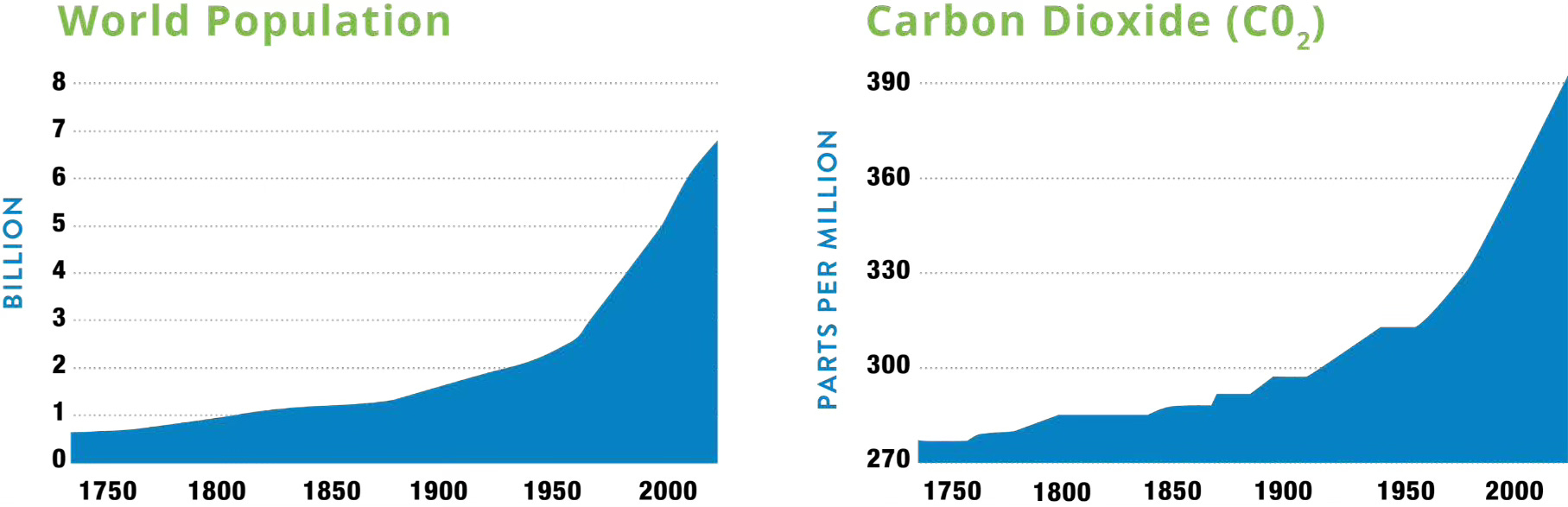
The more people on Earth, the more CO2 emission there are. The curves are loosely parallel. I have long viewed the world through this saying by Marshall McLuhan:
“There are no passengers on Spaceship Earth. We are all crew’
Well, the percentage of humanity that truly and regularly act as crew is woefully small. So the more of us that there are means ever more CO2 emissions.
Finally, for those that do not follow population and the emissions as much as I have, I end with a chart that put everything about overpopulation in true historical context.
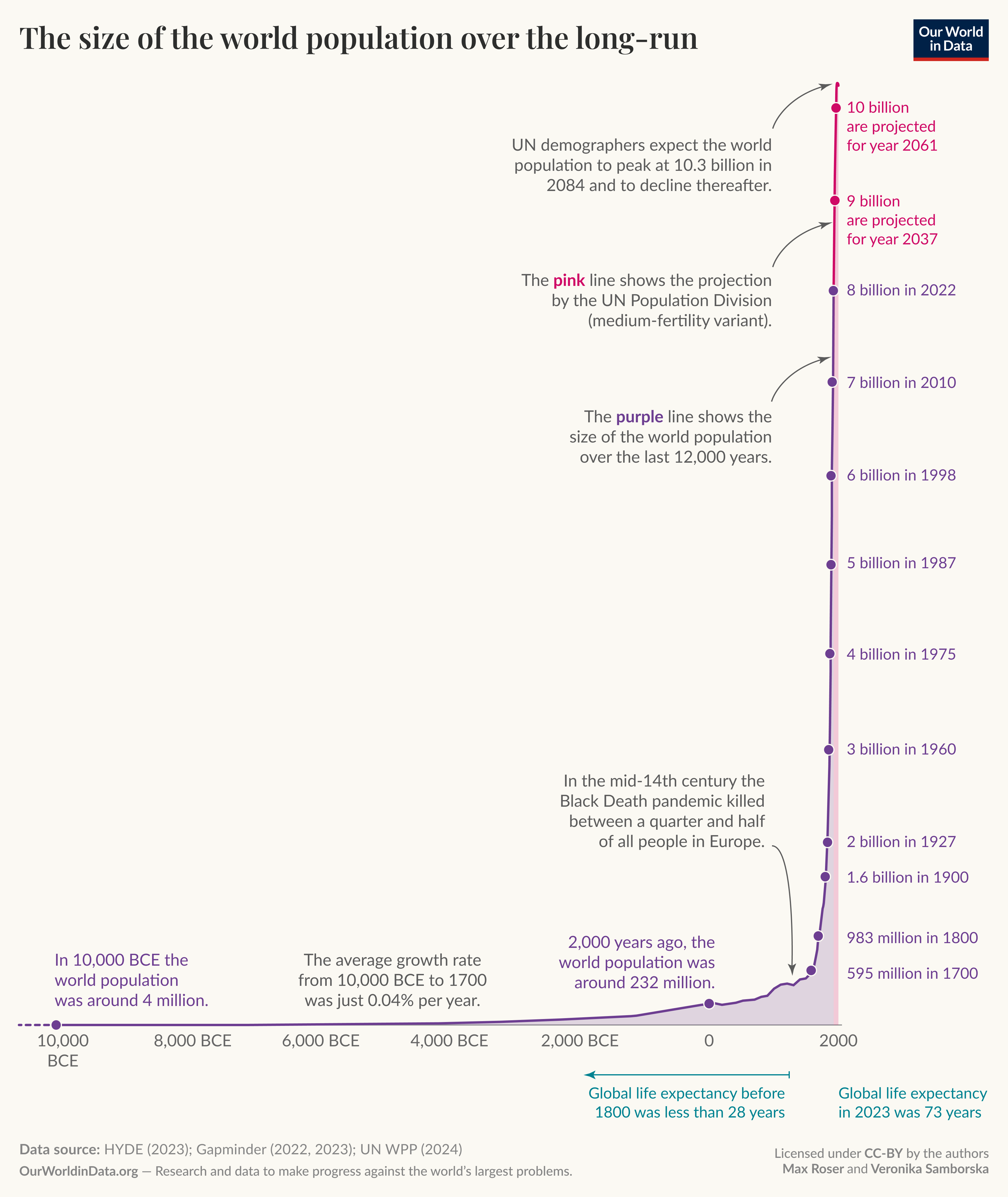
Please note that the verticality began after 1800. The population of humanity has increased some 850% since then. If you believe in Jesus, he walked the Earth when there were 232 million people alive. There has been about a 3500% increase since then.
Prior to the great early civilizations some 5-10,000 years ago, it has been estimated that there were some five trillion trees on Earth. Then the Agricultural Age began, humanity literally started to put down roots and billions of trees were cleared. The Earth was in balance then as five trillion trees did and would have absorbed CO2 emissions even up to 1800. There are currently an estimated three trillion trees or 60% of what the Earth initially had. During this 10,000 years we have almost halved the number of trees, while increasing our population by 3500%
The expected population growth in 2026 is expected to be 28 million which is the equivalent of close to four New York Cities. Every day of this year there will be more than 121,000 new humans . This is a net number, subtracting deaths from births.
Overpopulation is one of the many problems This Spaceship Earth has. Much more on this next week when I post the interview with Christopher Tucker.
[Please share this column with anyone who you think might be interested in it. Please hit the like button below. If you are a founding member or a paid subscriber, you can post comments. I really would like to see any comments you have on this column. Thank you so much for your support!]