
The Big Things that are starting in the 2020s

In the three books I wrote about the 2020s – the most disruptive decade in history- I suggested that during this decade some major dynamics would begin. Toward the end of the 21st century, historians will look back and see that it was in this current decade that the beginnings of what shaped the century began. We really are living at the beginning of a century of massive change. Of redefinitions. Of what it means to be human. Of what civilization must do for their citizens. Humans will be different at the end of the century based upon what is starting in the 2020s.
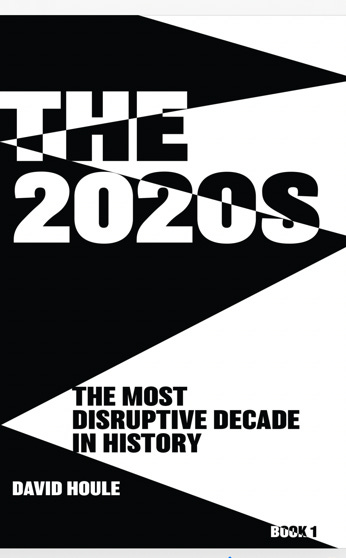
To quote from one of those books, published in 2020-2022:
“In Book One of this series, I set forth the four overarching
dynamics of the 2020s:
• The Age of Climate
• The Age of Intelligence
• The Reinvention of Capitalism and
Democracy
• A New Emerging Consciousness
Most of the changes in this decade can be placed under one
of these four dynamics. They represent the major
constructs that we will have to matriculate. The degree to
which we are forewarned we can anticipate. The amount of
anticipation we can bring will help us to flow with the rapid
changes. Anticipating these changes will also help us
minimize the cognitive dissonance resulting from all the
adaptations needed. Here are some challenges that
everyone reading this book will have to meet to one degree
or another.
Work and the workplace will evolve:
• What you do for a living will likely change.
• How you do your work will most certainly change.
• Past measurements of success will largely change.
There will be entirely new metrics for success.
• Where you work will change.
• Your income and/or revenue will not derive solely
from your work.
• The Age of Intelligence will dramatically alter how
we work, collapse the workforce, and provide
entirely new ways to work.
How we live and how we consume will change in
significant ways:
• The Age of Climate will deliver a collective reality
for facing this existential threat. That will force
changes in how we live.
• We will view consumption differently. We will move
to “Conscious Non-Consumption.”1 Conspicuous
consumption will become conspicuous non-
consumption.
• All forms of transportation will dramatically change.
• There will be a complete overhaul of our energy
sources, delivery systems and usage.
• The Age of Intelligence will profoundly change how
we live, how we interact with others, how we work
and how we consume.
Economics and the Global Economy
• Humanity first (#humanityfirst) becomes a more
dominant dynamic overshadowing even the
transition to stakeholder value.
• The global wealth inequality gap will continue to
grow. This threatens social and cultural stability.
Nations will have to address it or risk populist
uprisings.
• New tax structures and more comprehensive safety
nets will be created.
• The last 30 years of debt underpinning the global
economy will have to be reckoned with. There will
be an unprecedented financial disruption.
• Digital banking, digital currency, digital investments
and digital assets will trigger rapid and massive
changes to banking systems.
• 20% of the global GDP will undergo profound
disruption as the world moves from 75% of all
energy coming from fossil fuels to 25 to 40% by
2030. This will have cascading consequences
through the global economy. There will be explosive
growth in all forms of clean energy. The oil and gas
industry will first experience massive losses, and
then new revenue as it finds its place in an anti-
carbon world.
• Transportation is also 20% of the global economy.
There will be more than just a transition from
Internal Combustion Engine (ICE) vehicles to
electric and hydrogen-powered vehicles. The Age of
Intelligence will enable an ever-increasing number of
autonomous/driverless vehicles. Electric airplanes
with 500-mile ranges will be deployed.
• Wars between nation states over trade, resources
and capital flows will evolve to more integrated
global coordination and oversight.
• There will be a growing understanding, due in large
part to our climate crisis, that Gandhi’s quote
reflects our new reality: “There is a sufficiency in the world
for man’s need, but not for man’s greed.”
Democracy
• During the early part of the 2020s, democracy will
continue to be attacked around the world. Autocracy
will be on a temporary ascendency in the first part of
the decade, but will collapse in the second half.
• Democracy will seem to be less democratic and less
accessible.
• Technology will flood into democracies to increase
speed, transparency and efficiency. What we now do
on our smartphones in health, investments and
social media we will be doing relative to our
participation in democracy.
• Universal broadband coverage will enable real time
voting electronically.
Facing Our Climate Catastrophe
• How we live, where we live and in what
accommodations we live will change for many.
• How we consume, what we consume and how much
we consume will evolve.
• How we travel and what types of transport we use
locally, nationally and globally will change.
• Creating a global authority for planetary policy will
elevate discourse up from the nation state level.
Climate is a global issue and must be addressed by
all of humanity.
• To avoid long-term degradation of civilization,
massive near-term changes in how humanity lives on
spaceship earth will be mandated.
• The global workforce will continue to transition to
work at home or distributed workplace models.
Education at All Levels
• K-12 education will diversify. Technology, including
A/R and V/R, will be integrated into learning. The
trend toward learner-centric customized instruction
85rather than grouping by age into grades will rapidly
accelerate.
• As with everything else, there will be a move from
delivery in a specific place to delivery in multiple
places online and off. K-12 will change its funding
model from simple local real estate taxes to other
forms of tax revenue.
• The several centuries old model of college – a single
teacher lecturing a room full of students – will
continue, but will gradually be augmented or
replaced by other teaching models.
• A fundamental flaw in the legacy model of higher ed
is that the costs have risen faster than almost any
other area in the last 50 years. Student loan debt and
cost versus value will be addressed.
• In general, as it has almost everywhere else in
society, technology will disintermediate old forms of
delivery systems.
Medicine and Healthcare
• COVID-19 has, in many areas, condensed years of
change into a single year. The pandemic has revealed
the failures of practically every country’s public
health system. Few countries demonstrated
preparedness for the virus.
• Countries that have strong national health systems,
such as the U.K., Israel and the UAE have done
better with vaccine distribution than the private for-
86profit U.S. system. The COVID catastrophic death
event in the U.S. will trigger the development of an
on-going “just in case” public health plan that stands
in readiness for the next virus.
• By the end of the 2020s, the U.S. will replace its
current, profit-focused health care system. Which
will create another significant, yet positive,
disruption.
• The major change agents in medicine will be Big
Data, Technological Intelligence and DNA. Key
treatments will be customized to individuals.
Technological Intelligence already has a track record
for more accurate diagnoses of early-stage disease
than doctors.
• Digitization will transform health care. One example
will be embedded chips with one’s medical history
(no more filling out forms on clipboards).
• Memory will be fully mapped in the brain this
decade. One result will be a technological solution
to memory loss via memory chips.
Entertainment
• COVID has collapsed years of change in
distribution models and delivery systems into
months. Streaming is the new default choice for
viewing at home or on mobile.
87• The physical distribution models of movies,
perfected in the 20th century, will remain but in a
much reduced capacity.
• Virtual Reality will finally take off with the next
couple of VR goggle generations improved in size
(smaller), functionality, price and with the
embedding of sensory triggers.
• The Internet will increasingly become the backbone
for all entertainment. With live-streaming via VR
and AR technologies, streaming will begin to
approximate the in-person experience.
Communications
• New smartphone hardware features and functions
will slow. There will be some leaps ahead with
holographic interactions and projection from our
smart handheld devices.
• As 5G unfolds in the developed countries, it will
bring live, real time, multi-streaming immediacy to
tens of millions. This will deliver a major upgrade to
personal and corporate communications.
• Embedded communication chips will enable choices
for people wishing to be liberated from handheld
devices.
• Brainwave computer interface will become
mainstream by the end of the decade, enabling
the next step of human evolution by combining
technological intelligence with human intelligence.
88• There is a possibility for real-time uploading of
thoughts, then memories, then consciousness to the
cloud, where it can be retrieved and shared with
others.
Family, Relationships, Offspring
• Legacy thinking around our concept of a nuclear
family will collapse.
• The Millennial and Digital Native generations will
have far fewer children than any prior generations.
• The binary idea of man/woman in sexual
relationships will grow in gender fluidity.
• Diversity will grow in acceptance everywhere around
the world.
• Multi-racial relationships will continue to increase in
number and acceptance.
• The influence of organized religion on society will
decrease as younger generations move away from
religion.
Money and Finance
• Global indebtedness has already increased
substantially with COVID-19. It will continue to
increase until sometime in the mid-decade when a
debt reset crisis will occur.
89• Digital currencies and a distributed financial system
will become a viable alternative to centralized
finance and fiat currency.
• There will be micro crypto or digital currencies
within cities, regions, and groups. These “mini-
digital” currencies will be designed to solve local or
regional problems, create closed-loop groups and
even be earned for services as a new digital form of
barter. Entire communities or transnational
organizations will have discrete digital currencies
with qualities unique to the group.
So in practically every sector of human activity, society and
economics there will be significant change. Work,
transportation, energy, money, work-life balance, concepts
of family, human habitats, will all experience massive
changes. For those not comprehending this disruptive
time, a severe amount of cognitive dissonance is in store”.
The current situation with Trump/Minneapolis/ICE/DHS/Greenland that we are living through, is a microcosm of all this change. We are learning what is truly important for citizens to do to protect Democracy in America. In other words, we are realizing that some things will always remain dear to us. That is a very important thing to keep in mind when undergoing massive change. What is it that is worth keeping and holding on to amidst change.
More in future columns from these books. To understand the bigger contextual dynamics that are starting this decade is essential to being able to live through all this massive change.
Please continue to hit the like button below. Please forward on columns you like to friends who you like might enjoy reading. Thank you so much!