
Interview with Clement Vidal / Part 2

My conversation with Big Questions Philosopher was so full of great concepts and insights that it had to be broken into two parts. This is Part 2. Part 1 is here]
First, I want to ensure that all subscribers have access to Clement’s website and TEDx talk. Please take a look at both!
Back to the Conversation with Clement Vidal
DH: You are affiliated with the Free University of Brussels (Vrije Universiteit Brussel). What is your position and role there?
CV: I am a researcher associated with the interdisciplinary Center Leo Apostel, whose goal is to build integrated worldviews. This means that we focus on synthesis and integration, as opposed to the fragmentation and specialization of knowledge.
DH: You are also currently at the University of California Berkeley and its Berkeley SETI Research Center. Please elaborate on your involvement.
CV: I’m a visiting researcher at UC Berkeley, working in astrobiology. Still no conclusive evidence has been found either to support a sign of biology (a biosignature) or a sign of technology (a technosignature). Of course, nobody knows what kind of signature we’re going to find first, and in such a setting of high uncertainty, it is most reasonable to assume that both strategies have equal chances of success. Yet, humans have dedicated and are currently dedicating many more resources (people, instruments, funding) to search for biosignatures rather than to search for technosignatures. Why? This discrepancy intrigues me. I’m in favor to give equal attention and opportunity to biosignature and technosignature search strategies to improve the overall chance of finding ET life.
DH: What are your thoughts about life elsewhere in the cosmos [whatever is the right term here]? Could there be “life” that is unlike “life” on Earth?
CV: My own research focus is on technosignatures and more precisely on non-communicative technosignatures. Indeed, when we look for signals coming from space, we’re actually looking for a subset of all potential intelligent civilizations: the ones that want to communicate (or that communicate involuntarily leakage radiation). What if they don’t want to communicate?
The great physicist Freeman Dyson proposed back in 1960 to look for “Dyson Spheres”, a product of a civilization that would harness all the energy of its parent star. Because the swarm of solar collectors would heat, they would leave some inevitable infrared excess that would be detectable. I proposed a variation on this idea, where the method of harnessing energy would be through accretion unto a compact object. Such civilizations would be eating stars, and I call them “stellivores”. I’m still trying to assess whether we might have spotted stellivores in our astrophysical data. For the curious reader, I also wrote the script of a short animation that leads to this idea.
The strategies to search for life-as-we-don’t-know-it require general theories about life, that are independent of the concrete implementation, or the “hardware” of life. This is sometimes called the search for “agnostic biosignatures” or the search for “exotic” lifeforms. To understand why it makes sense, let us look at the history of computer hardware. We have implemented computers with electromechanical relays, vacuum tubes, transistors, and integrated circuits. Maybe, given enough time, lifeforms could transition their “living hardware” from biochemistry to other kinds of hardware that would provide significant adaptive advantages. Or more simply, our universe might afford many pathways to self-organize and complexify structures up to living forms. What matters is that the “software” of life can run, not the constraints of a particular hardware implementation.
DH: Clément, in your bio on your website you say in your mission statement:
“In the last few decades, cosmology provided us great insights about our place in the universe. However, scientific worldviews strive to be value-free, leaving the problem of how we can give meaning to our lives. We need a broader philosophical worldview that attempts to answer our existential and ethical questions. This worldview will encourage people to find a meaning of life in harmony with cosmic evolution”.
SO, how are you doing that?
CV: This mission is a lifelong pursuit, but a first step is to develop a third story of the universe (see Part I of the interview). If religions are to be an inspiration, they also provide more than just a story, but rather stories that together form an ethical and meaning systems as well as guidelines for action, that are reinforced through rituals. That’s going far beyond academia, but in the end, why couldn’t our actions and rituals be informed and infused not only by religions, but also by a broader evolutionary understanding and culture?
DH:Reading your work, in Part 1 of our conversation, was the first time that I have seen the concept of the third story. Brilliant! So that is what the Noosphere and Evolutionshift are, attempts at a third story?
CV: Yes, the third story aims to go beyond the shortcomings of religious stories (“first stories”) and the limited scope of narrow science (“second story”), to envision credible futures that can provide meaning and purpose. These futures need to be based on evolution and have a global scope, so the Evolutionshift and the Noosphere are key. See also Part I of the interview for some more details.
DH: Okay, recently ChatGPT showed the world what the possibilities of AI might be. You and I used it relative to our requests to comment about the Noosphere. What are your thoughts about AI? Start somewhere.
CV: AI is finally delivering! AI had been promising a lot already decades ago, and focused on formal logic and rigid inference rules, with little breakthroughs. When I started my master’s degree in cognitive sciences in 2005, many students and I were excited to learn about artificial neural networks… only to be disappointed that that they were actually useful in rather narrow cases. Deep learning algorithms are of course at the heart of the breakthroughs that we see today, but their power is unleashed thanks to the growth of big data on which they can train, and the rise of computational power, especially GPU.
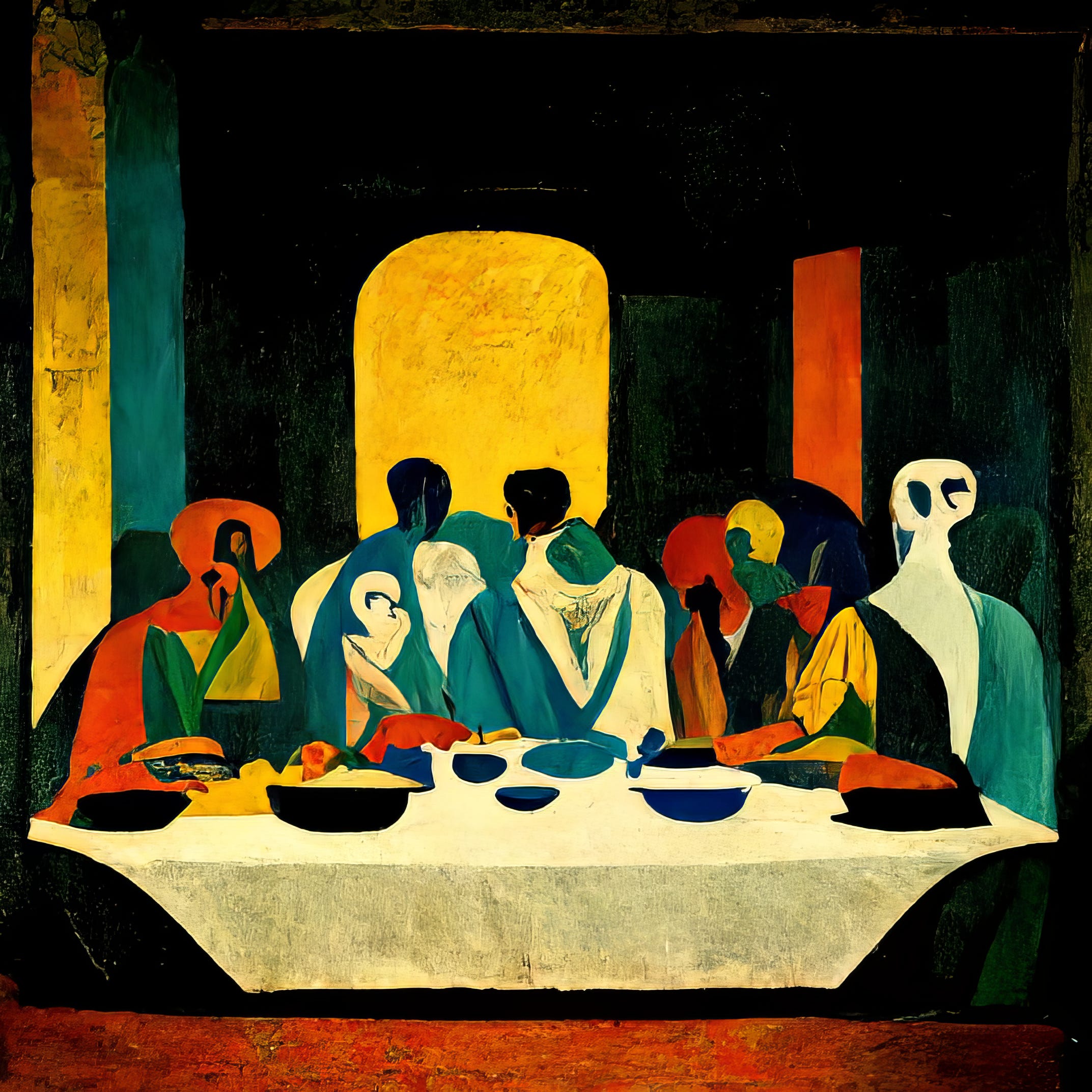
The last few months have been especially amazing with stable diffusion models generating artistic images (e.g. Midjourney and DALL-E. These models have been trained to associate words with millions of images, and are able to create entirely original images, simply based on a text prompt. There are many applications, but one that I like is to “AI-ressurect” great artists. For example, it’s now possible to ask a grandmaster to “paint” a masterpiece of another. Here I asked Midjourney to generate: “The Last Supper by Pablo Picasso”:
The other amazing development is ChatGPT. It can write crystal clear summaries of complex ideas, but also computer programs, poetry, tutorials, translations, re-write text, story plots, etc. When I introduce it to friends, I always suggest: ask it a very difficult question in a domain that you know really well. Each time, the answer is not only correct, but also insightful and informative.
Some like to argue that ChatGPT has no “real” intelligence… but what do we mean by “real”? A first reply is to recognize that its answers are very practical and usable, so at least in this pragmatic sense, its intelligence is very real.
Also, it’s not because some software doesn’t replicate exactly how humans process information that it can’t be intelligent in some way. A pocket calculator is much smarter than any human to make basic calculations. Deep Blue beat Kasparov in chess by using a rather brute-force method. Alpha-Go won the Go game by having been trained from human and computer games, but how it plays is much buried in a deep learning black box. ChatGPT has been trained on about 500GB of text (it’s a lot of text, although this data can fit in a modern microSD card) and uses deep learning and natural language processing methods. In these examples, the AI doesn’t build models of the world by interacting with it, like we do as humans. My point is that AI algorithms may have started by imitating human information processing, but they have also diverged from it in significant ways.
DH: As an Art History major and lover of art, that Picasso version of The Last Supper is nothing less than transformative. My mind goes to all the mash-ups that could happen. [A column on that soon.]
DH: Clément, where are you on the timeline view into the future when certain potentialities of AI might appear and become widely used?
CV: AI is already widespread with text, face or voice recognition, in video games, in science, and even in art, as we just saw. Probably most AI computing happens without us noticing. As I said in Part I of this interview, the timeline between now and 2040-2100 is likely to be an amazing explosion of AI.
DH: As a futurist, I have always had my eye on AI, but it always seemed to be the “next big thing” that never was, UNTIL the DeepMind AI-system Alpha-Go beat Lee Sedol, the world's greatest GO player in 2016. Then I truly started to realize that AI was, in fact, becoming THE next big thing. My question is about the term Artificial Intelligence. I have long thought that one of the reasons that humanity has reservations about AI is the name. That subliminally, subconsciously, something that is called artificial is not to be trusted. The anthropocentric view that if it isn’t US it isn’t real. When I looked up the word “intelligence” in five dictionaries, not one of them had the word “human” in their definitions. Of course, whales are intelligent, dolphins are intelligent, and even people claim their pets are “intelligent”. This led me to start using the phrase “technological intelligence,” as that seems to be a more accurate term for what is going on and what it is. What are your thoughts? Why use the word artificial, as it seems to be real intelligence that is manifesting within technology?
CV: I do like your proposal of “technological intelligence” (TI), and your arguments are compelling. The term “artificial intelligence” (AI) may indeed have created a sense of opposition with “human intelligence”, which might have made many people scared of AI. My philosophy is to reverse this logic: instead of fearing AI as an external threat, we should see the creation and development of AI/TI as an act of generosity! By this I mean that we are giving, offloading, and offering the essence of human cognitive capacities to other mediums, allowing them to be amplified in speed and capacity and distributed globally. I wrote a paper about the formation of the global brain / noosphere happening with this dynamics. More precisely, I argue that global intelligence grows through our efforts to externalize and distribute cognitive functions such as memory, computation, navigation, hearing, vision, but also emotions and actions. At the end of the paper (pp 346-351), I showed how such a vision could unfold with a short science fiction story called “A day in 2060”.
Back to the word “artificial”, I’ve had a similar discussion about a cosmological scenario involving advanced intelligent life. It is a variation on Lee Smolin’s Cosmological Natural Selection theory, where intelligent life would do some tinkering, some “artificial selection” to make a new universe and thereby bypass an ultimate cosmic doom scenario. So in my book I named the scenario “Cosmological Artificial Selection”, while my colleague John Smart prefers “Cosmological Natural Selection with Intelligence”, to avoid the negative connotations of the word “artificial”. Should I change my mind?
Going back to the case of AI vs TI, the discussion is also pragmatic: will you (or a small group of people) be able to make the world shift from using the word AI to TI? Would it be worth the effort? Once a concept has been coined and widely adopted, it can become very hard to change.
DH: How do you see AI/TI within the vision of the Noosphere?
CV: AI/TI is an essential part of the development of the Noosphere, specifically on the development of cognition at a planetary scale. As we have seen, the recent breakthroughs in deep learning have mostly been possible thanks to big data that is actively generated and collected in the noosphere. Such breakthroughs are also extremely quick to diffuse throughout the globe – a fact that we consider trivial, but that sustains accelerating change.
There are still many challenges related to AI/TI, to implement it with the sensing of real-time data, with effectors interacting with the real world, to improve human-computer interactions, but also to use it for tackling global issues related to the geosphere and the biosphere. Indeed, a true planetary nervous system would need to be able to sense and govern all aspects of the global system. Of course, it needs to be an effort where both humans and AI/TI are involved, as offloading all our decision making to AI/TI may not be the smartest choice…at least in the short-term future.
DH: Any final thoughts until we meet again?
CV: It has been a very rich conversation, thank you and your readers for making it happen. To paraphrase Miguel de Unamuno’s quote that you analyzed: “We should try to be the parents of our future rather than the offspring of our past”, I would add “We should try to be the parents of artificial intelligence rather than to oppose it”. This begs the question: what does it mean to be a good parent for artificial intelligence?
DH: Clement, thank you so much for expanding my mind, and, hopefully the minds of the readers of Evolutionshift!
Now, here is what Clement and I separately asked of ChatGPT relative to the Noosphere, Evolutionshift, the Metaverse and the Singularity
